

The Power
of Patients
Autonomous patient and/or caregiver behavior will deliver unparalleled medical advancement in healthcare!

Despite No Medical Education or Experience, consumers, have: Fully-aligned Intent and Ample Time to contribute towards accurate diagnoses, positive outcomes and understanding.
Consumer Responsibility
Fully-aligned Intentions
and Ample Time
Consumer Behavior

Their most basic responsibility for Consumers to enact their aligned-intentions and ample time for favorable outcomes is data aggregation.
Consumers are the only custodian of Longitudinal Health Records (LHR), including data collected by the provider and wearable, behavioral data from the patient.
Complete real-time LHRs provide the exhaustive data for more accurate diagnoses, effective treatment and improved disease understanding.
Moreover, consumers have (or bestow) the opportunity to feed complete real time LHRs into Large Language Models (LLM) for their benefit. LLM's have the power to analyze perviously incalculable data for the time-restricted-human bandwidth.
Intent
Time
Provider
— Overworked Patient-loads
— Personal Lives
— Fear of Malpractice
— Fiduciary Duty
Committed to provide the best-possible-care, providers have Restricted “Time” and “Intent”:
$4.7 Trillion Produces 60 Zettabytes of Health Data; Less than 1% is Openly Accessible

Silos of Sources
Electronic medical records (EMR) is fragmented across various providers, EMR vendors. In addition far-outpacing Patient Contributed Data (PCD), like wearable, mobile and genomic data can only come from the consumer

Privacy Restrictions
Federal privacy policy, such as HIPAA, prevent health systems and EMR vendors from openly accessing and sharing any collected personal and clinical data without direct consent by the Consumer

Business Interests
Health systems and EMR vendors are not financially incentivized to promote data interoperability. Conflict of business interests and fear of malpractice from accepting outside data disincentives data sharing.

Incomplete Data
Even with policy from like 21st Century Cures Act, and interoperability standards of Fast Healthcare Interoperability Resource (FHIR®), errors, gaps, and moment-in-time data limitations make complete real-time longitudinal health records (LHR) impossible without the custodianship of the consumer
Paradigm Shift
Longitudinal Health Record (LHR) Data Sets are possible for the first time with the Participatory Role of Consumers, Access Mandates of the 21st Century Cures Act and Health Data Standards of HL7® FHIR®


21st
Century
Cures

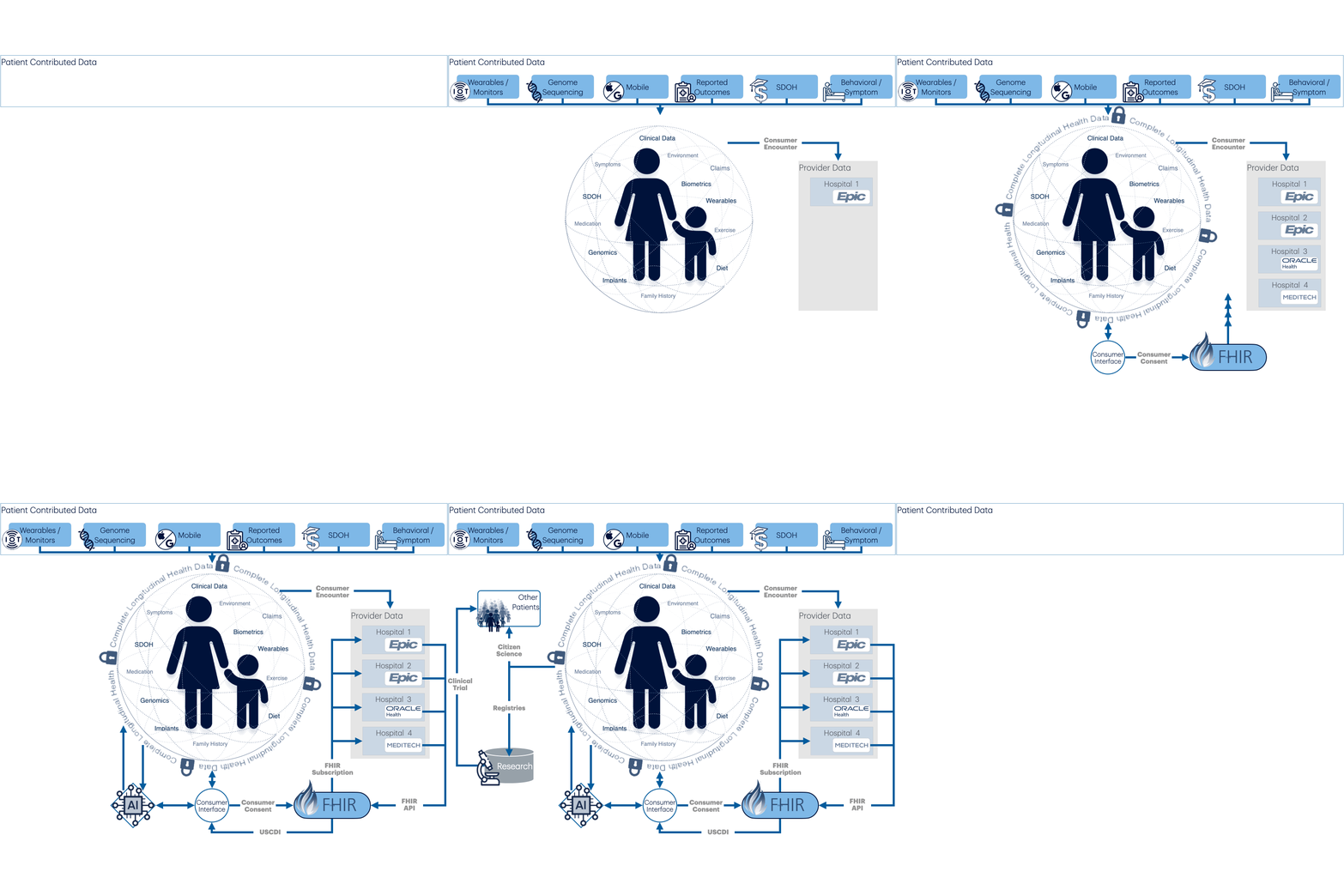
Longitudinal Health Record
ABOUT
Participatory.Health was founded by digital product and UX designer James Cummings after his two young sons were born with unrelated rare diseases. His experiences navigating complex care systems revealed the profound gaps in how health data is accessed, standardized, and used to improve outcomes.
The organization’s mission is to modernize healthcare by empowering patients and caregivers — the true custodians of longitudinal health data — to aggregate, control, and share their complete health records.
Participatory.Health focuses on resolving data standardization inefficiencies, addressing policy barriers, and exposing data-blocking behaviors that prevent meaningful interoperability and machine learning (ML) advancement. Participatory.Health operates with the belief that the future of health data begins with consumers. Patients and caregivers may lack formal training, but they possess two critical assets: fully aligned intentions and abundant time to contribute to better outcomes. As genomic, wearable, environmental, and behavioral data increasingly outpace traditional clinical records, consumers will become the primary custodians of their longitudinal health records (LHRs).
To accelerate this inevitable future, Participatory.Health is designing a replicable process that enables consumers to aggregate their data, connect fragmented systems, and make their records available for clinical, research, and AI use. The initiative begins within the rare and undiagnosed disease communities — where participatory behavior and data aggregation are already advanced — demonstrating how patient-led data commons can exponentially improve disease understanding, diagnosis, and treatment.
Participatory.Health envisions a healthcare ecosystem where data travels securely with the individual, empowering consumers, clinicians, and researchers to collaborate in real time — and unlocking the full potential of machine learning as a diagnostic, treatment, and discovery companion.


